Address
Building C2, Zhanglong Logistics Park
Shiting Sub-district, Xiangcheng District, Zhangzhou City
Fujian Province, P.R. China
Work Hours
Monday to Friday: 7AM - 7PM
Weekend: 10AM - 5PM
Address
Building C2, Zhanglong Logistics Park
Shiting Sub-district, Xiangcheng District, Zhangzhou City
Fujian Province, P.R. China
Work Hours
Monday to Friday: 7AM - 7PM
Weekend: 10AM - 5PM
In 2025, sustainability is no longer a niche marketing tactic for brands—it’s a business imperative. As regulatory pressures mount and consumers demand transparent, eco-conscious practices, self-adhesive labels—once overlooked as a minor packaging component—have emerged as a critical touchpoint for sustainability progress. The global sustainable labels market is projected to grow at a 6.2% CAGR through 2030, driven by innovations in materials, printing technologies, and circular design principles. This guide breaks down the top trends shaping sustainable self-adhesive labels in 2025, highlights the most impactful eco-friendly materials, and provides actionable strategies for brands to implement these solutions while boosting SEO visibility and consumer trust.
The sustainable labeling landscape in 2025 is defined by a shift from “less harmful” to “regenerative” practices, with technology and regulation acting as dual catalysts. Below are the trends reshaping how brands approach self-adhesive label sustainability.
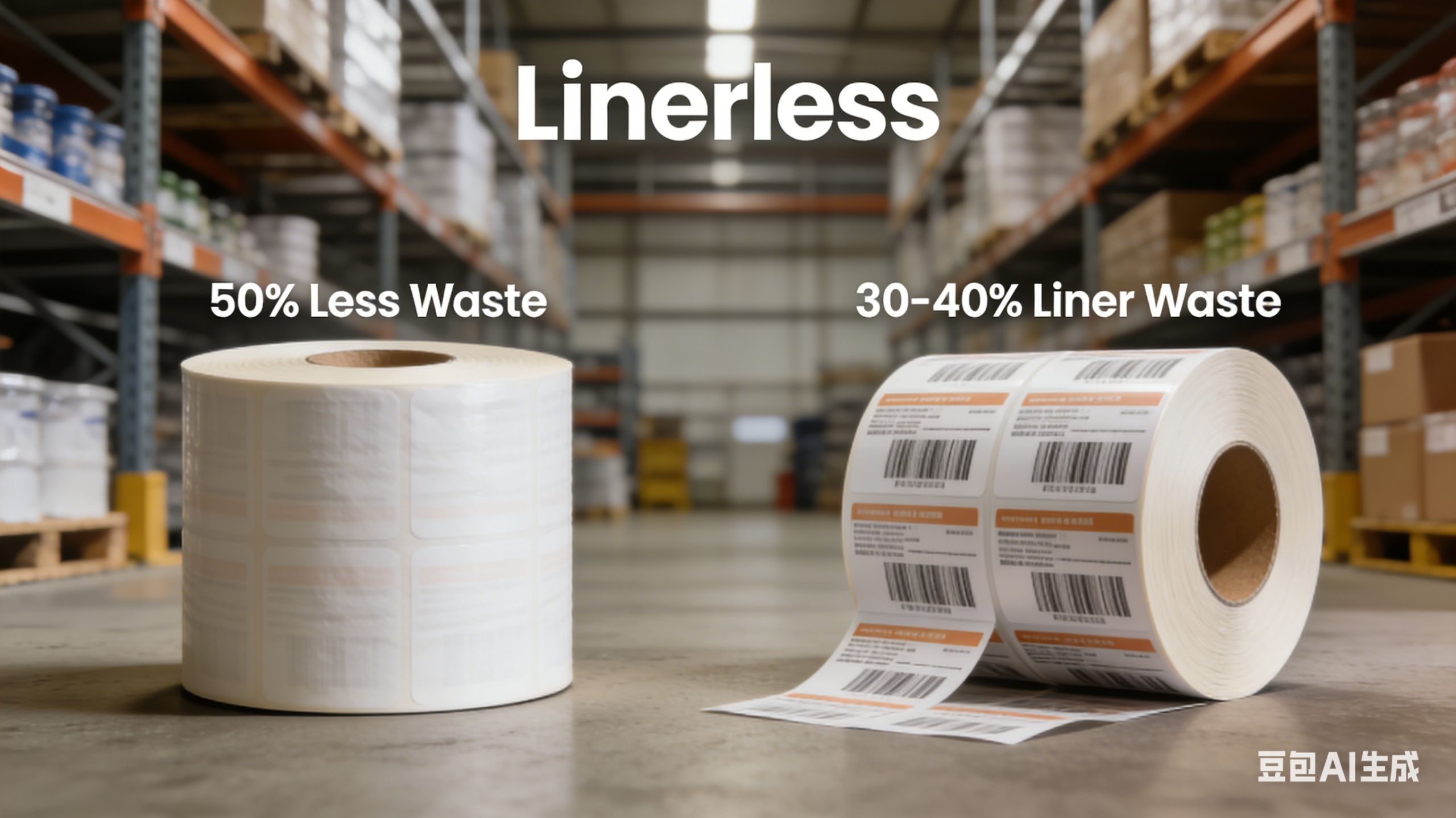
Linerless self-adhesive labels have become one of the fastest-growing segments, with the market expected to reach $2.58 billion by 2032 at a 4.1% CAGR . By eliminating the non-recyclable backing liner that typically accounts for 30-40% of label waste, these labels address a longstanding pain point for brands. The benefits extend beyond sustainability: linerless designs reduce roll diameter by up to 50%, cutting storage costs and lowering carbon emissions during transportation. For high-throughput industries like e-commerce and logistics, the 40% increase in printing time per roll (thanks to longer roll lengths) translates to less downtime and higher productivity .
Brands like Amazon and DHL have already adopted linerless labels for shipping packages, citing waste reduction of 15+ tons annually per facility. For SEO optimization, integrating terms like “linerless sustainable labels 2025” and “zero-liner self-adhesive labels” helps capture search intent from operations and sustainability managers.
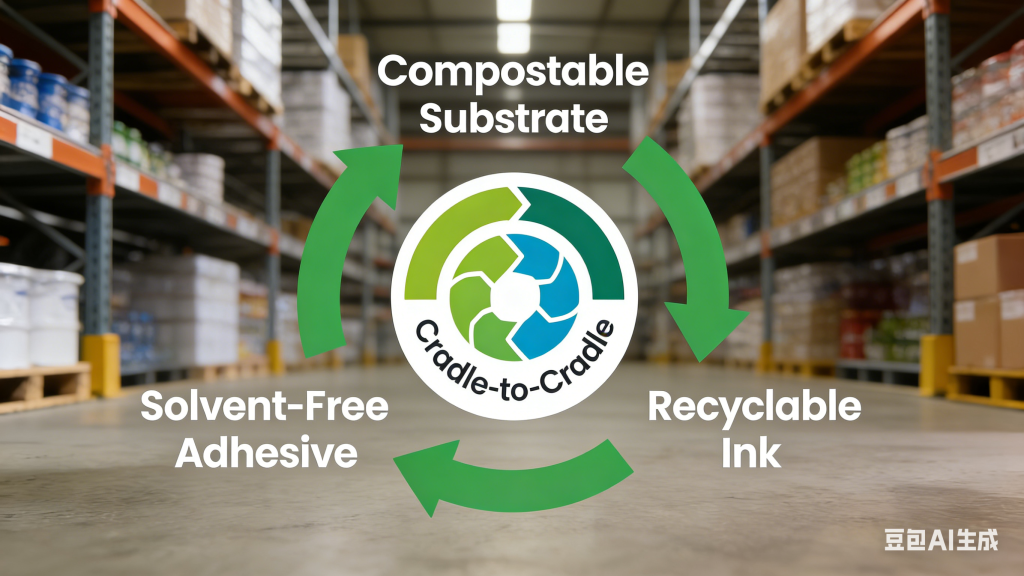
2025 marks the rise of “closed-loop” label systems, where every component—substrate, adhesive, ink— is designed for reuse, recycling, or composting. Industry leaders are partnering to create end-to-end solutions: Avery Dennison’s RDX MC paper-based label, when paired with Armor-IIMAK’s AWR XL thermal transfer ribbon, reduces plastic use by 26% and cuts CO₂ emissions by 830g per roll compared to standard products . The RDX MC material itself delivers 5% water and CO₂ savings through its thinner, lighter formulation, without compromising adhesion or durability.
This trend is closely tied to regulatory compliance, particularly with the EU’s Packaging and Packaging Waste Regulation (PPWR), which mandates 65% recycling of all packaging by 2030. Brands leveraging circular label systems can highlight terms like “cradle-to-cradle self-adhesive labels” and “PPWR-compliant sustainable labels” to align with search queries from compliance-focused decision-makers.
Digital printing has become the gold standard for sustainable label production, replacing traditional methods that generate significant setup waste. On-demand printing allows brands to produce labels in exact quantities, eliminating excess inventory that often ends up in landfills . HP Indigo printers, a favorite among sustainable label manufacturers, operate with a “cradle to factory door” carbon-neutral footprint and use a Regenerating Imaging Oil (RIO) system that reclaims and recycles imaging oil, reducing liquid waste by up to 50% .
For small and medium-sized brands, digital printing enables short runs (as low as 1,000 labels) with full customization, making sustainable labels accessible without large upfront investments . SEO-focused phrases like “digital printed eco-friendly labels” and “on-demand sustainable self-adhesive labels” resonate with brands seeking cost-effective, green solutions.
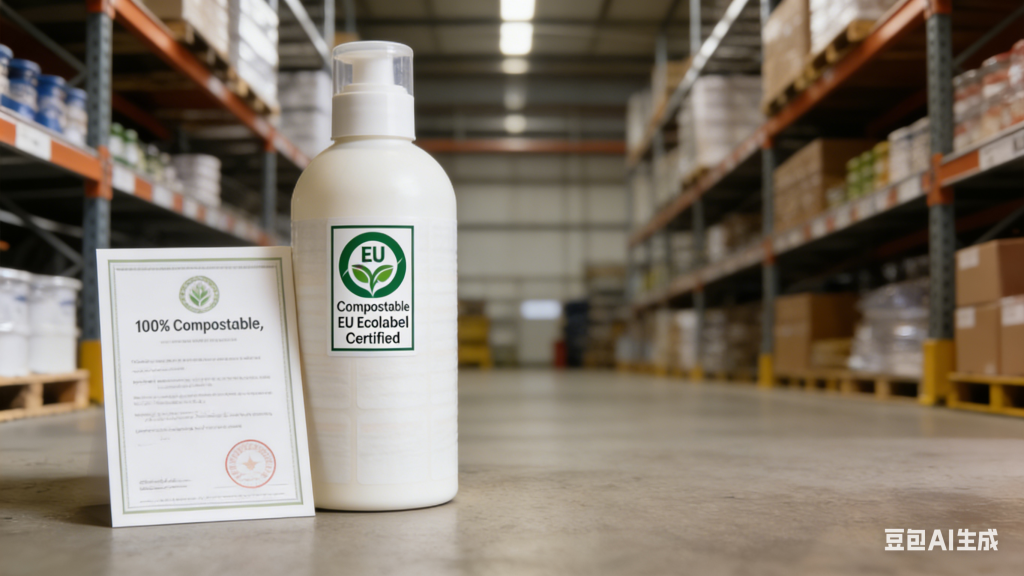
Consumers and regulators are cracking down on unsubstantiated “green” claims, making third-party certifications a non-negotiable in 2025. The EU Ecolabel—recognized across 32 European countries—stands out as the most trusted credential, awarded only to the top 10-20% of environmentally friendly products . Labels bearing this certification must meet strict lifecycle requirements, including reduced hazardous chemicals, lower CO₂ emissions, and easy recyclability.
Other key certifications include DIN CERTCO (for compostability) and FSC (for paper-based substrates). Celanese’s home-compostable fruit and vegetable labels, for example, hold TÜV DIN certification, ensuring they break down completely in home compost without leaving microplastics . Brands should incorporate certification-specific keywords like “EU Ecolabel self-adhesive labels” and “DIN CERTCO compostable labels” to attract trust-driven search traffic.
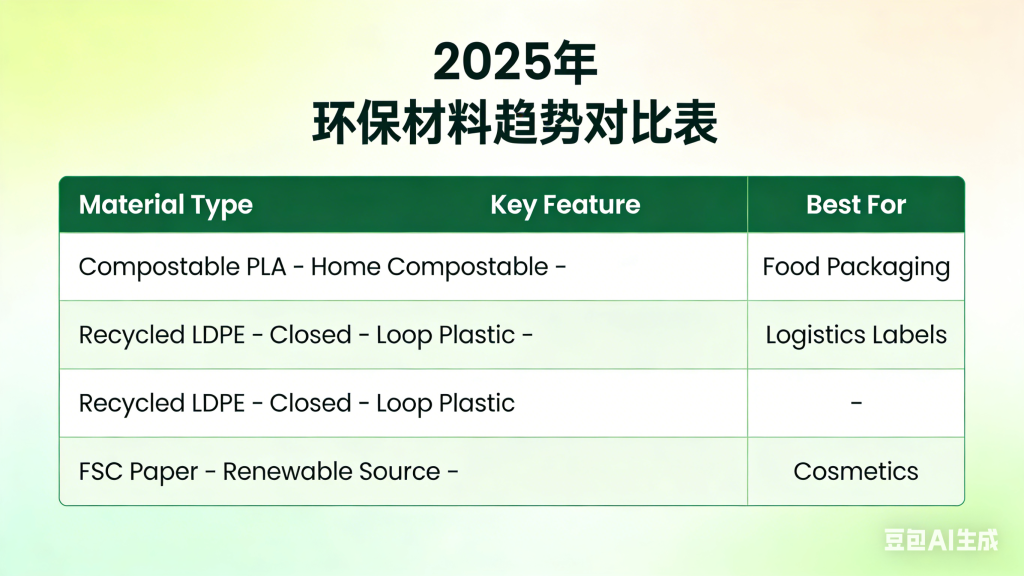
The material selection defines a label’s sustainability footprint. In 2025, brands are prioritizing materials that balance environmental performance with functional needs—adhesion, durability, and compatibility with packaging substrates.
Compostable materials, made from renewable resources like PLA (polylactic acid), PBAT (polybutylene adipate terephthalate), and cellulose, are gaining traction for food, beverage, and personal care labels. Celanese’s Clarifoil® cellulosic bio-white film, paired with BioTak® HC700 adhesive, creates a fully home-compostable label that adheres to moist, textured produce surfaces (like bananas and tomatoes) while breaking down completely in 12-16 weeks . Unlike traditional plastic labels, this solution eliminates the need for consumers to remove labels before composting—reducing contamination of organic waste streams.
A key consideration: industrial vs. home compostability. PLA-based labels require industrial composting facilities to break down efficiently, while cellulose-based options work in home compost . Brands targeting eco-conscious consumers should use keywords like “home compostable self-adhesive labels” and “PLA sustainable labels” to clarify their offering.
Recycled plastic films—made from post-consumer or post-industrial LDPE waste—are a practical alternative for brands unable to adopt compostable solutions. These films perform identically to virgin plastic but reduce reliance on fossil fuels and keep existing plastic out of landfills . The key advantage is compatibility with existing recycling infrastructure: most grocery stores in the U.S. and Europe accept thin plastic films via drop-off programs, making disposal familiar for consumers.
Avery Dennison’s recycled PET label substrates, for example, contain 50% post-consumer recycled content and are fully recyclable in PET recycling streams. Brands should highlight terms like “recycled LDPE self-adhesive labels” and “closed-loop plastic labels” to appeal to circular economy-focused buyers.
Paper remains a staple for sustainable labels, with innovations focusing on reducing water and energy use during production. Avery Dennison’s RDX MC paper substrate is 15% thinner than traditional label paper, using less fiber while maintaining strength . FSC-certified paper, sourced from responsibly managed forests, is a must for brands prioritizing supply chain transparency.
Paper-based labels excel in industries like cosmetics and gourmet food, where a “natural” aesthetic aligns with brand values. For SEO, phrases like “FSC-certified sustainable labels” and “biodegradable paper self-adhesive labels” capture search intent from brands in these sectors.
Adhesives are often overlooked, but they play a critical role in label sustainability. In 2025, solvent-free adhesives are standard, eliminating volatile organic compound (VOC) emissions during production. Bio-based adhesives, made from soy or corn derivatives, are gaining ground—Elevate Packaging’s compostable labels use a plant-based PSA that meets ASTM D6400 and EN 13432 standards .
For recyclable labels, “detackable” adhesives are a game-changer: they dissolve during the recycling process, preventing contamination of paper or plastic recycling streams. Brands should emphasize “solvent-free eco-adhesives” and “recyclable label adhesives” to address a key pain point for sustainability managers.
Adopting sustainable self-adhesive labels requires a holistic approach that balances environmental goals, regulatory compliance, and brand communication. Follow these steps to maximize impact:
Match label materials to your primary packaging: use compostable labels for paper-based packaging, recycled films for plastic containers, and linerless labels for high-volume shipping. For example, a organic snack brand might choose cellulose-based compostable labels, while a logistics company would benefit from linerless recycled film labels.
Display certifications prominently on labels and your website—include QR codes linking to certification details to build trust. For EU markets, the EU Ecolabel is non-negotiable; for U.S. consumers, DIN CERTCO and FSC labels resonate. Use product descriptions that include certification keywords to boost SEO.
Collaborate with suppliers that offer end-to-end sustainable solutions, like the Avery Dennison-Armor-IIMAK partnership . These partners can help navigate regulatory requirements (like PPWR and SFDR 2.0 ) and ensure your labels meet performance standards.
Incorporate a mix of high-volume and long-tail keywords throughout your website, product pages, and blog content. Focus on: Trend-focused terms: “2025 sustainable self-adhesive labels,” “linerless label trends 2025”Material-specific terms: “compostable PLA labels,” “recycled LDPE self-adhesive labels”Compliance terms: “PPWR-compliant labels,” “EU Ecolabel sustainable labels”Industry-specific terms: “food-grade compostable labels,” “logistics linerless labels”
Celanese’s Clarifoil® and BioTak® HC700 label system addresses a critical issue for grocery retailers: produce label contamination of organic waste. Traditional plastic labels often end up in compost bins, where they break down into microplastics. Celanese’s solution is fully home-compostable, adhering to moist produce surfaces during transport while disintegrating completely in home compost .
Since launching in 2025, a major UK supermarket chain has adopted the labels for bananas and berries, reducing organic waste contamination by 40%. The labels’ breathable design also reduced banana ripening by 20%, cutting food waste—a double win for sustainability. The brand’s product page, optimized with keywords like “home compostable produce labels” and “TÜV DIN certified labels,” saw a 35% increase in organic search traffic within three months.
In 2025, sustainable self-adhesive labels are more than a compliance measure—they’re a powerful tool for brand differentiation and consumer trust. By embracing trends like linerless design, circular systems, and digital printing, and selecting materials like compostable cellulose and recycled films, brands can reduce their environmental footprint while meeting growing demand for eco-conscious products.
The key to success lies in transparency: highlight certifications, share your sustainability journey, and optimize your digital presence with targeted SEO keywords. As regulatory pressures and consumer expectations continue to rise, brands that invest in sustainable labels today will position themselves as leaders in the circular economy tomorrow.